
RELEASE: Lee & Durbin: According to CBO, Smarter Sentencing Bill Would Reduce Prison Costs by More Than $4 Billion
Sep 15, 2014
Assistant Majority Leader Dick Durbin (D-IL) and Senator Mike Lee (R-UT) announced today that their bill tomodernize nonviolent drug sentencing policies would reduce prison costs in America by $4.36 billion over 10 years, according to a new report compiled by the nonpartisan Congressional Budget Office (CBO)
Protecting Freedom of Speech
Sep 11, 2014
“Attention all citizens! To assure the fairness of elections by preventing the disproportionate expression of the views of any single powerful group. The government has decided that the following associations of persons shall be prohibited from speaking or writing in support of any candidate.” This is a statement that I have taken directly from a dissenting opinion issued by associate justice Antonin Scalia in a case called Austin v. Michigan Chamber of Commerce. A 1989 ruling of the Supreme Court of the United States.
South Korea Honors Utah's Veterans of the Korean War
Sep 10, 2014
Today members of staff from my office were invited to attend a ceremony in the Utah State Capitol Building to honor 181 of the 17,000 Utahns who fought in the Korean War. They were presented with the South Korea Ambassador for Peace Medal.
Top Obama Administration Officials Raise Questions about Arming Syrian Rebels
Sep 10, 2014
Earlier this year, during hearings of the Senate Armed Services Committee, I had the chance to ask CENTCOM Commander General Lloyd Austin and the Director of National Intelligence James Clapper about the risks of arming and assisting rebel groups in Syria. Their responses were very troubling. As the president shares his plan for how to address national security threats in the Middle East, I hope to find his plan takes into account the concerns raised by these high-ranking officials.
The following is a question for the record that I submitted to General Austin and his response:
Senator Lee Questions General Austin on Providing Assistance to Syrian Rebels
This is a video of my exchange with Director of National Intelligence, James Clapper:
Here is the transcript of this exchange:
LEE: Thank you, Mr. Chairman. And thank you for joining us today. Director Clapper, you said in an Intelligence Committee hearing in January that one of the extremist groups operating in Syria, the Al-Nusra Front, has aspirations for attacks on the United States. I was wondering if you could elaborate a little bit on this, and tell us whether or to what degree Al-Nusra has the capability or is close to developing the capability of attacking the United States?
CLAPPER: This has been a tenet of theirs ever since they formed up, is ultimately planning for and attempting to execute an attack on the homeland. I think right now this is more aspirational than operational. We have seen evidence of the emergence of training camps, for example, that have the familiar signatures from Afghanistan days. Probably of greater concern, as I mentioned in my opening statement, are some Al Qaida veterans from the Afghanistan-Pakistan area, a small nucleus of them who have also moved to Syria, which has served as a magnet for many of these extremists. And they do harbor designs on -- and this is separate from Al-Nusra -- harbor designs on attacks on the homeland -- in Europe and the homeland.
LEE: So there are other groups there that potentially present a threat to us?
CLAPPER: Yes.
LEE: What proportion of the rebel fighters in -- in the Syrian conflict would -- would you and others in the intelligence community characterize as extremist? And -- and what level of influence do you think they have on the entire group?
CLAPPER: The number is somewhere in the neighborhood of, altogether opposition fighters, somewhere in the neighborhood of the low range of 75,000 to 80,000, maybe to 110,000 and 115,000. And somewhere in the neighborhood of between 20,000 and maybe up top range of 26,000 we regard as extremists. And they are disproportionately influential because they are among the most effective fighters on the battlefield.
LEE: So would you say that there is -- there is a significant relationship, then, between the Al-Nusra Front, especially when you add in other extremist elements, and what many people refer to as the more moderate -- the more moderate elements of the rebel forces in Syria?
CLAPPER: In terms...
LEE: Yes, so the question is, is there a significant relationship, then, between the extremist elements and what we're calling the moderate elements?
CLAPPER: Well, they are an agreement of convenience, I would say. Oftentimes, these groups will apparently -- which are quite fluid, by the way -- may disagree ideologically, but will, if it's convenient for them in a tactical context, will -- will agree to work together.
LEE: Sure.
CLAPPER: Of course, we've had the falling out now with the ISIL, and where the -- they are fighting other opposition groups.
LEE: But given this relationship of convenience, as you describe it, there is, I assume, frequently coordinating going on -- sharing of information; perhaps sharing of equipment that goes on between extremist elements and moderate elements.
CLAPPER: Well, that's -- that's hard to say, sir. I mean, this is a very fluid kind of thing. There are some 1,500 or 1,600 of these groups, various fighting groups. And they align themselves and realign themselves constantly. So it's very hard to make generalized statements about that.
LEE: Warehouses of items provided as assistance to moderate rebels were, as you know, seized by some Islamist groups in December. Was Al-Nusra involved in that seizure?
CLAPPER: I'll have to research to see which groups were involved in the warehouse seizure. I don't know off the top of my head.
LEE: And to your knowledge, is there anything that -- anything that was seized in connection with that -- that raid in December that has subsequently been used by Al-Nusra or by any of the other extremist groups?
CLAPPER: We don't know. I -- I can't say, sir.
A visit to Switchpoint
Sep 3, 2014
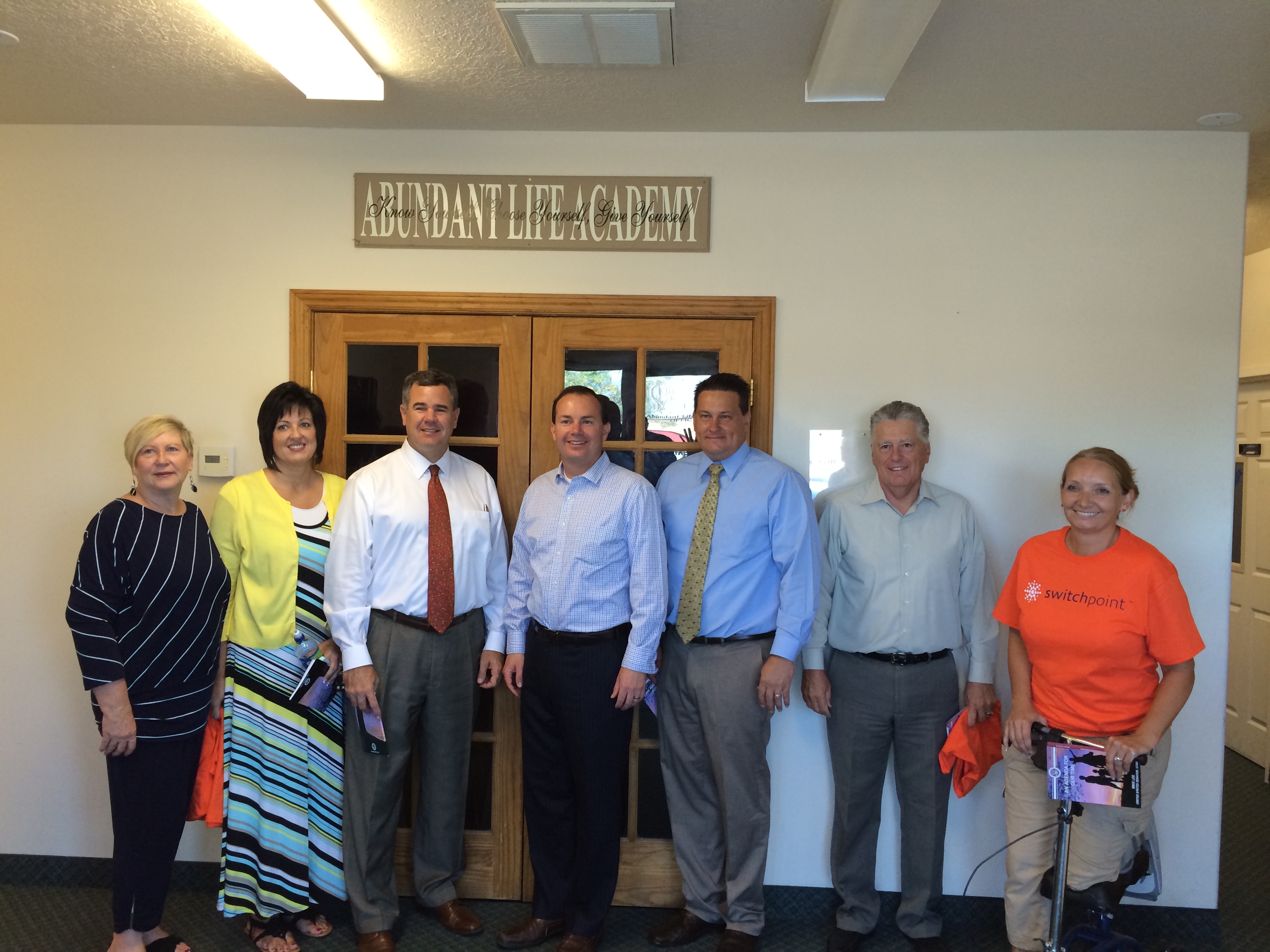
In a recent trip to St. George, I was invited to tour Switchpoint: a new facility in the area that provides temporary shelter and support for the homeless community in Washington county. I was joined by St. George City Councilmembers Bette Arial, Michele Randall, and Jimmy Hughes; Mayor John Pike; and City Manager Gary Esplin. Carol Hollowell is the director of Switchpoint, and she led the tour.
Last November, I delivered a speech about reducing poverty entitled, Bring Them In. In this passage from the speech I highlighted one of the principles for reducing poverty that is often forgotten in policy debates:
We usually refer to the free market and civil society as “institutions.” But really, they are networks of people and information and opportunity. What makes these networks uniquely powerful is that they impel everyone – regardless of race, religion, or wealth - to depend not simply on themselves or the government, but on each other. For all America’s reputation for individualism and competition, our nation has from the beginning been built on a foundation of community and cooperation.
In a free market economy and voluntary civil society, no matter your career or your cause, your success depends on your service. The only way to get ahead is to help others do the same. The only way to look out for yourself is to look out for your neighbors.
As I toured Switchpoint, I was convinced that their model that relies primarily on the institutions of civil society is a model that policies that are intended to reduce poverty need to follow. The institutions of government had a small role to play in helping Switchpoint secure their building. One of their innovations of the facility is to designate an area where 17 non-profit partners and local government agencies can be available to those who visit the facility. The bulk of the effort that is utilized to run this facility is provided by volunteers. Local organizations of contractors and local businesses donated materials and labor for renovating and modernizing the facility. Another group donated computers that can be used by those who visit the facility to search for work, fill out forms and paper work, participate in job training programs, and develop new skills. Religious groups donated crucial resources and volunteers as well.
Donated Materials and Bedroom Furniture
Computer Kiosks for Donated Computers
Aside from this community assistance, much of the operation of the facility will depend on the volunteer work of those who are receiving its services. While I was touring the kitchen, a woman who was receiving assistance from Switchpoint was helping maintain the kitchen and preparing lunch.
Learning About Kitchen Volunteer Program
I was certainly impressed by Switchpoint's innovative approach to making poverty more temporary, but I was not surprised to see this innovation coming from from my fellow Utahns. This is why as part of my Conservative Reform Agenda, my proposals that are designed to provide opportunity and upward mobility to those who are struggling focus primarily on shifting power from Washington DC to the states, local governments, and local communities that can truly make a difference to those they serve.
Americans need a new, comprehensive anti-poverty agenda that not only corrects – but transcends – existing policies, and I believe Switchpoint is an organization that proves we can meet this challenge.
The Utah Solutions Summit: Starting a Dialogue on Regulatory Reform
Aug 22, 2014
Yesterday I joined with the Salt Lake Chamber and the Governor’s office to host the Utah Solutions Summit. This event provided a venue for Utah business leaders and government officials to come together to discuss the vast and uncertain regulatory state with which businesses are required to comply. The event was also an avenue to find solutions to government imposed burdens placed on economic development. In addition to providing information about the role of regulation and regulation compliance through panel discussions, Senator Lee facilitated industry specific roundtable discussions. In these roundtables, industry leaders discussed ways to alleviate the burdens these regulations have on their companies with a representative from Senator Lee’s office, a representative from the Governor’s office, and others.
The summit began with an opening speech by myself, and I was followed by a keynote speech given by my friend, Senator Tom Coburn. Both speeches focused on over-reach at the federal level. I compared the federal government to a “helicopter parent,” with 80,000 pages of new federal rules handed down in 2013.
After the opening speeches, there were two panel discussions: A local regulation panel consisting of city officials and business leaders, and a state regulation panel consisting of economists, business leaders, and an agency director. These panelists examined and provided insight regarding the relationship between regulation and economic development.
Lt. Governor Spencer Cox spoke to the group at lunch where he presented examples on how regulation negatively affects innovation in the economy.
In the afternoon, attendees dispersed into industry specific roundtable discussions. The goal of these roundtables was to bring together representatives of businesses and industries to discuss the regulatory burden under which they are required to comply. Participants were asked to bring their most burdensome regulations to the summit as well as potential solutions they would like to put into place to address these problems.
We held roundtable discussions on these topics
-
Real Estate & Commercial Construction
-
Banking & Finance
-
Technology, Entrepreneurship, & Small
Business
-
Healthcare, Medical Devices, &
Pharmaceuticals
-
Transportation
- Energy, Natural Resources, & Public Lands
Mr. Wayne Crews, an expert from the Competitive Enterprise Institute in Washington, DC, provided a presentation on federal regulation for those attendees that did not participate in the roundtable discussions.
I am grateful for the time set aside and the effort made by those in attendance. The ideas driven through dialogue produced important strategies to address the vast regulatory burden your business faces every day.
Improving America's Regulatory Climate
Aug 21, 2014
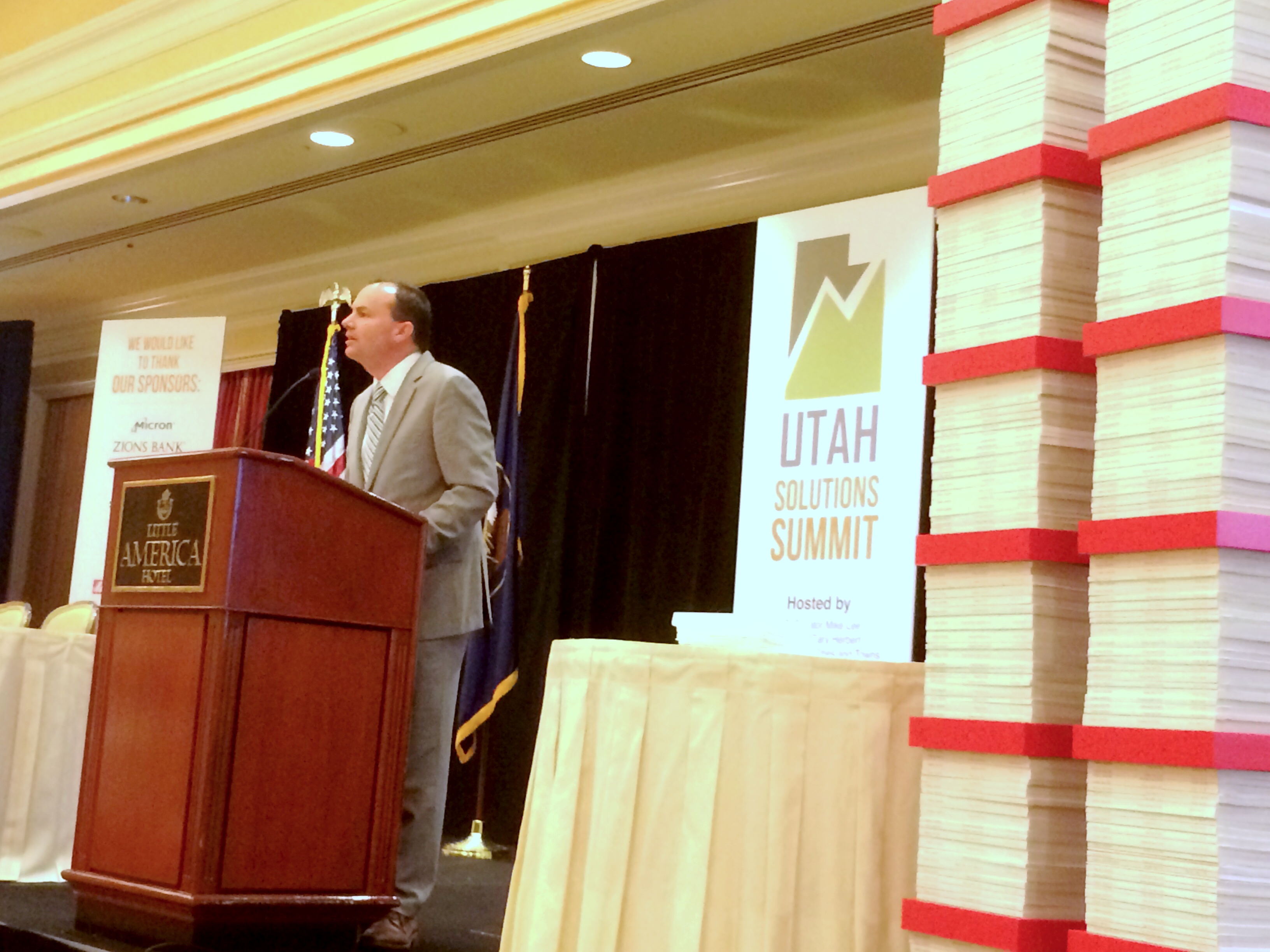
It is my distinct privilege to welcome all of you to the inaugural – and hopefully first annual – Utah “Solutions Summit.”
In future years, the theme of the conference will change, but the purpose will stay the same. We want to bring together Utah’s leaders – in business and civil society and all levels of government - to discuss what we can do together to meet the greatest challenges facing our state and our country.
Lee Announces Town Hall for Military Community and Veterans
Aug 14, 2014
SALT LAKE CITY – Senator Lee announces an upcoming town hall meeting that will focus on the needs of Utah’s veterans and military community. The event will be held on August, 26 at 7:30 – 9:00 p.m. At the Ed Kenley Centennial Amphitheater in Layton.
"As a member of the Senate Armed Services Committee, I have an important responsibility in guiding the actions Congress takes to maintain the capabilities of our armed forces to provide for our national defense,” Lee explains. "I also have the responsibility to ensure that we provide veterans who have served the country with the benefits and recognition that they deserve. The feedback I receive from those who are part of the military community is crucial in helping me effectively fulfill these responsibilities.”
This event will provide a valuable opportunity for the military and veteran community to meet Senator Lee and the members of his staff that advise the senator on legislation related to the military and veterans. His staff that helps veterans with federal casework will also be in attendance to offer their services to veterans that need additional help working with federal agencies such as the Department of Veterans Affairs.
All are invited to attend, but for those who are unable to attend, Senator Lee has made a form available on his website where constituents can leave their feedback or questions for the Senator to address during the town hall meeting. This form can be found here:
lee.senate.gov/UTVETMIL
Lee at Reagan Ranch: Answering Reagan's Challenge
Aug 13, 2014
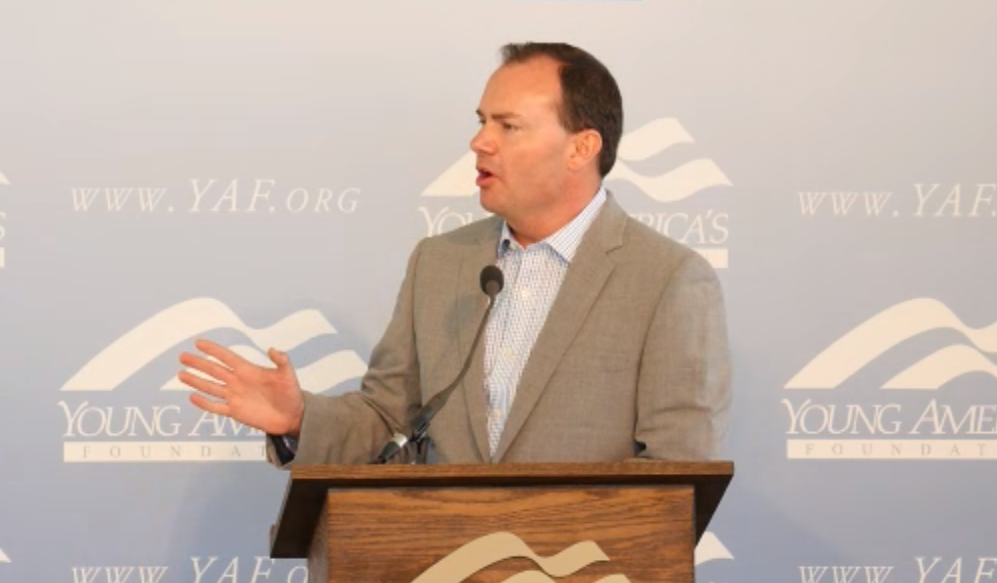
Today, Senator Mike Lee delivered a speech at the Reagan Ranch to commemorate the 33rd anniversary of President Reagan signing into law one of his first major economic reforms, the Economic Recovery Tax Act of 1981.
Answering Reagan’s Challenge
Aug 13, 2014
My first real exposure to the Reagan Administration occurred when I was about ten years old. My father, the late Rex E. Lee, served as the Solicitor General of the United States during President Reagan’s first term in office. It is the job of the Solicitor General to serve as the federal government’s advocate before the U.S. Supreme Court. Like every lawyer, the Solicitor General has a client—it’s the federal government, and specifically the presidential administration in power. As a practical matter, that meant that my dad was President Ronald Reagan’s voice in the Supreme Court.
